
Single-journey ticket or transit card on the Seoul subway?

CONNECT ON Inc. · How we verify · sources read SEP 6, 2026
Highlights
The short answer
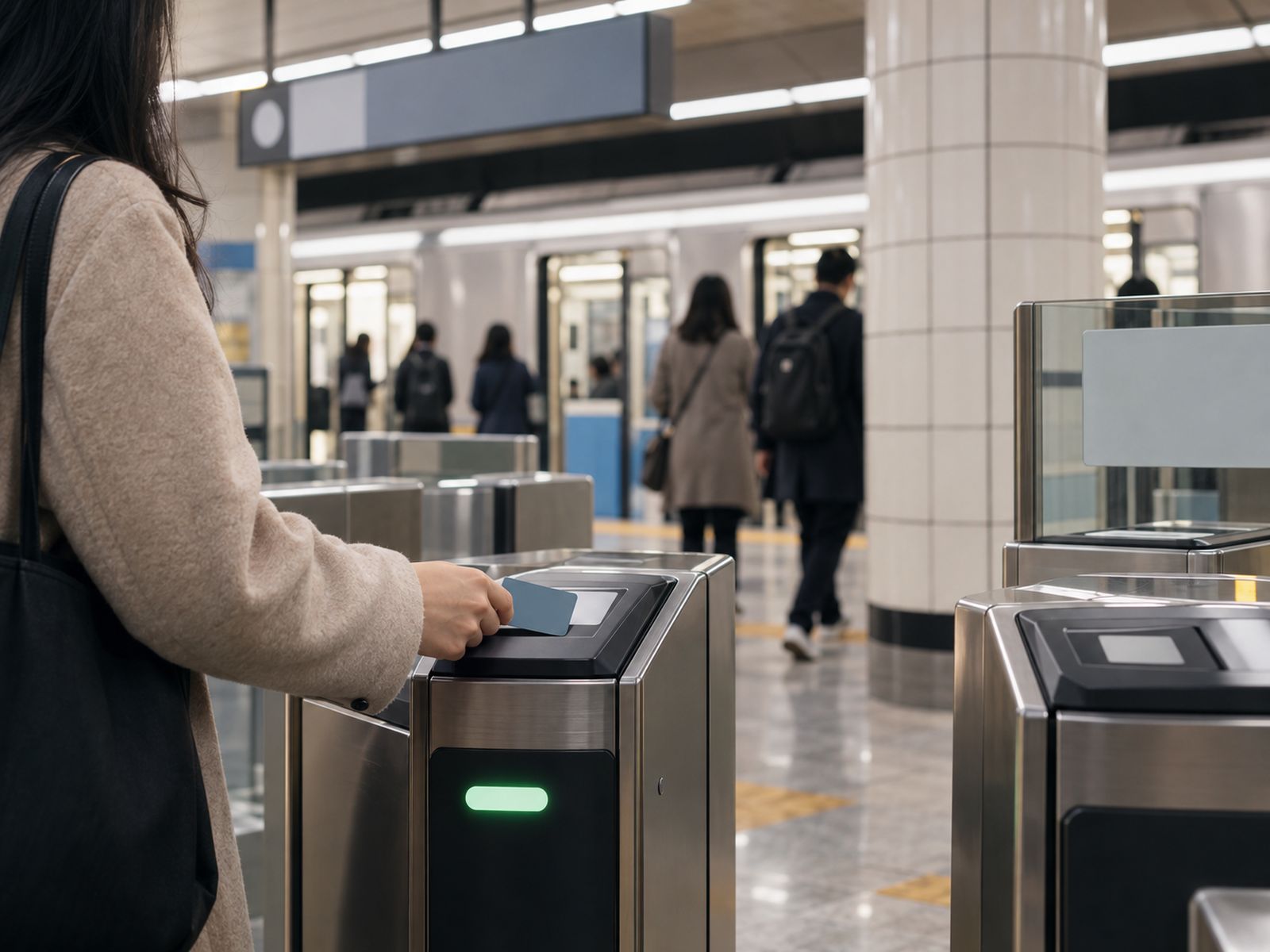
If you are a visitor riding the Seoul subway more than once or twice, a transit card is the cheaper option. A single-journey ticket costs more per ride than the card fare, carries a refundable deposit you have to queue to reclaim, and earns no transfer discount when you change to a bus. The card wins on any trip involving a change, which in Seoul is most of them. Fares below are the operator's published figures, verified in September 2026.
Getting Around · Subway · Bus · TaxiPhotograph: K Travel Way
What is the difference in fare?
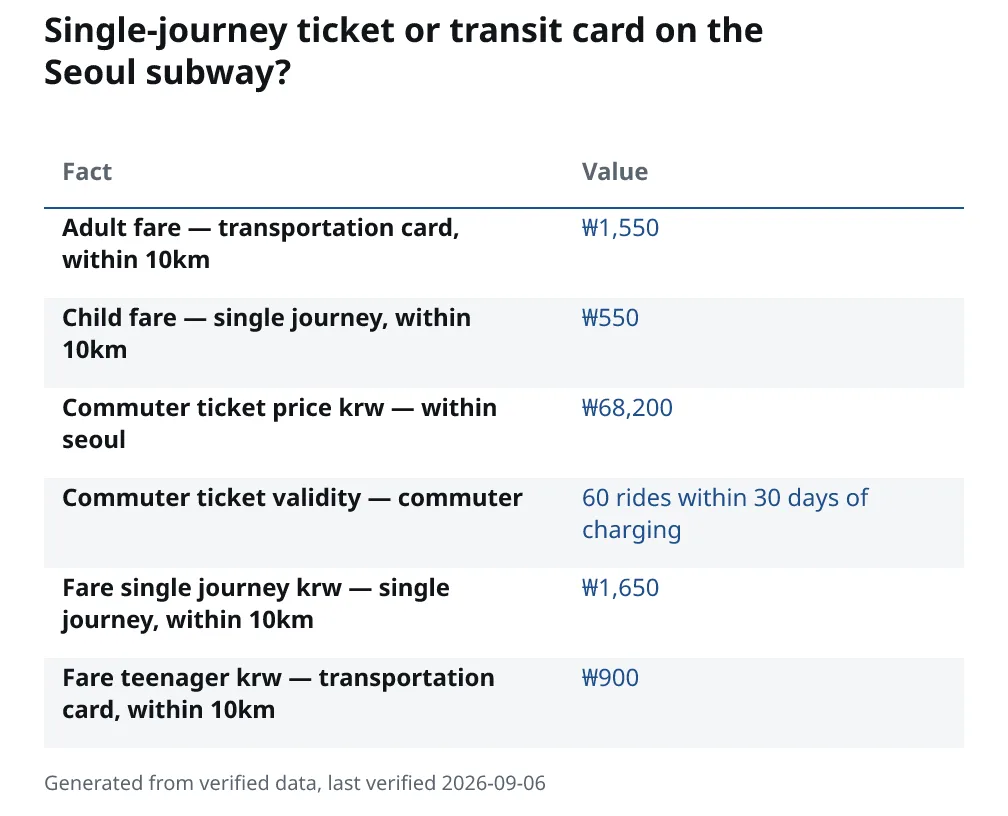
On 서울교통공사 (Seoul Metro) the base fare within the first distance band is ₩1,550 when you pay with a transit card. The same ride on a single-journey ticket is ₩1,650.
Beyond the base band the card fare adds distance: 100 KRW for every 5km between 10 and 50km; 100 KRW for every 8km beyond 50km.
What is the deposit on a single-journey ticket?
The single-journey card is reusable stock rather than a paper ticket, so it carries a returnable deposit of ₩500. You get it back at a refund machine after you exit — but only if you remember, and only if you are still inside the station.
That is the hidden cost of the single ticket: not the money, but the two extra stops at a machine on every journey.
When does the transfer discount decide it?
This is the part that usually settles the question. Transfer between bus and subway is free up to 10km, and up to 30km for Seoul metropolitan, Gyeonggi Express and Nonstop, and Incheon Express and metropolitan buses; the highest basic fare among the modes used is applied.
A single-journey ticket buys one ride on one system. If your trip is subway then bus — or bus then subway, which describes most journeys outside the centre — the card fare covers the change and the ticket does not.
What about children and teenagers?
The brackets are set by card type, not by the ticket: Child card: 6 to 13; teenager card: 13 to 19. A child on a single-journey ticket pays ₩550 within the base band, and a teenager on a card pays ₩900.
One rule catches families out at the gate: One ticket is valid for one person; the subway system cannot accept multiple passengers on one card. Two people cannot share a card through the barrier the way a bus driver can sometimes wave them through.
Can I get my money back at the end of the trip?
Yes, and this is why the card is not a sunk cost. A T-money balance can be refunded at any subway station; a damaged card needs a refund request form and takes about seven days.
The card's own purchase price is not refundable, so the honest comparison is: you lose the price of the card once, and save on every ride and every transfer after that.
What if I am only making one journey?
Then the single-journey ticket is defensible — one ride, no change, no reason to buy a card you will not reuse. 티머니 (T-money transit card) only pays for itself across several rides.
For a stay of more than a day, though, the arithmetic goes the other way quickly, and a pass may go further still. A monthly commuter ticket for travel inside Seoul costs ₩68,200 and gives 60 rides within 30 days of charging — far more than a visitor needs, but it shows where the operator draws the line between occasional and regular travel.
Questions people ask
Is the single-journey ticket more expensive than a transit card?
Yes. The card fare within the base distance band is lower than the single-journey fare, and the single ticket also carries a deposit you have to reclaim at a machine after each trip.
Do I get the deposit back?
Yes, at a refund machine inside the station after you exit. The deposit is returnable; the transit card's own purchase price is not.
Does a single-journey ticket cover a transfer to a bus?
No. The free transfer between bus and subway applies when you pay with a transit card. A single-journey ticket buys one ride on one system.
Can two people travel on one card?
No. One ticket is valid for one person and the subway gates are automated, so a card cannot be tapped twice for two passengers.
Sources
Related pages
Getting around
Can I Bring a Bicycle on the Seoul Subway?

Getting around
Do Seoul Subway-to-Bus Transfers Cost Extra?
SIM & eSIM