Seoul subway rules for visitors: passes, bikes, bags, lost items

MK Lee · How we verify · sources checked SEP 6, 2026
Highlights
The short answer
Visitors can ride the Seoul subway with a transportation card, a single-journey ticket or a commuter pass, a fixed bundle of rides that expires if unused within its window. The pass covers Seoul Metro Lines one to nine and the KORAIL and AREX sections within the Seoul area, although some transfers at Seoul Station are not possible with it. Bicycles are allowed only on Saturdays and national holidays, in the first and last cars. Luggage above a size or weight limit is restricted, with strollers, wheelchairs and folded bicycles exempt. If you leave something on a Seoul Metro train, call the lost and found centre for that line. Rules and prices were checked in September 2026.
Getting Around · Subway · Bus · Taxi
This guide covers the everyday rules of riding the Seoul subway as a visitor: which ticket to tap in with, how the commuter pass works and where it stops being valid, what you can bring on board (bicycles, suitcases and pets), and what to do if you leave something on a train. Check Seoul Metro's own page before you buy a pass in case anything has changed.
Which ticket should I use on the Seoul subway?
The ways in through the gates include a transportation card, a single-journey ticket and the commuter pass covered in the next section.
Transportation cards come in two kinds. Transportation cards are either a prepayment card (charged in advance, topped up when empty) or a deferred payment card (a credit card with the transit feature added, billed monthly). This guide uses T-money as its example of a prepaid card. T-money transit cards can be bought at any subway ticket office, and the card itself costs ₩2,500. The card price is separate from any balance you load onto it.
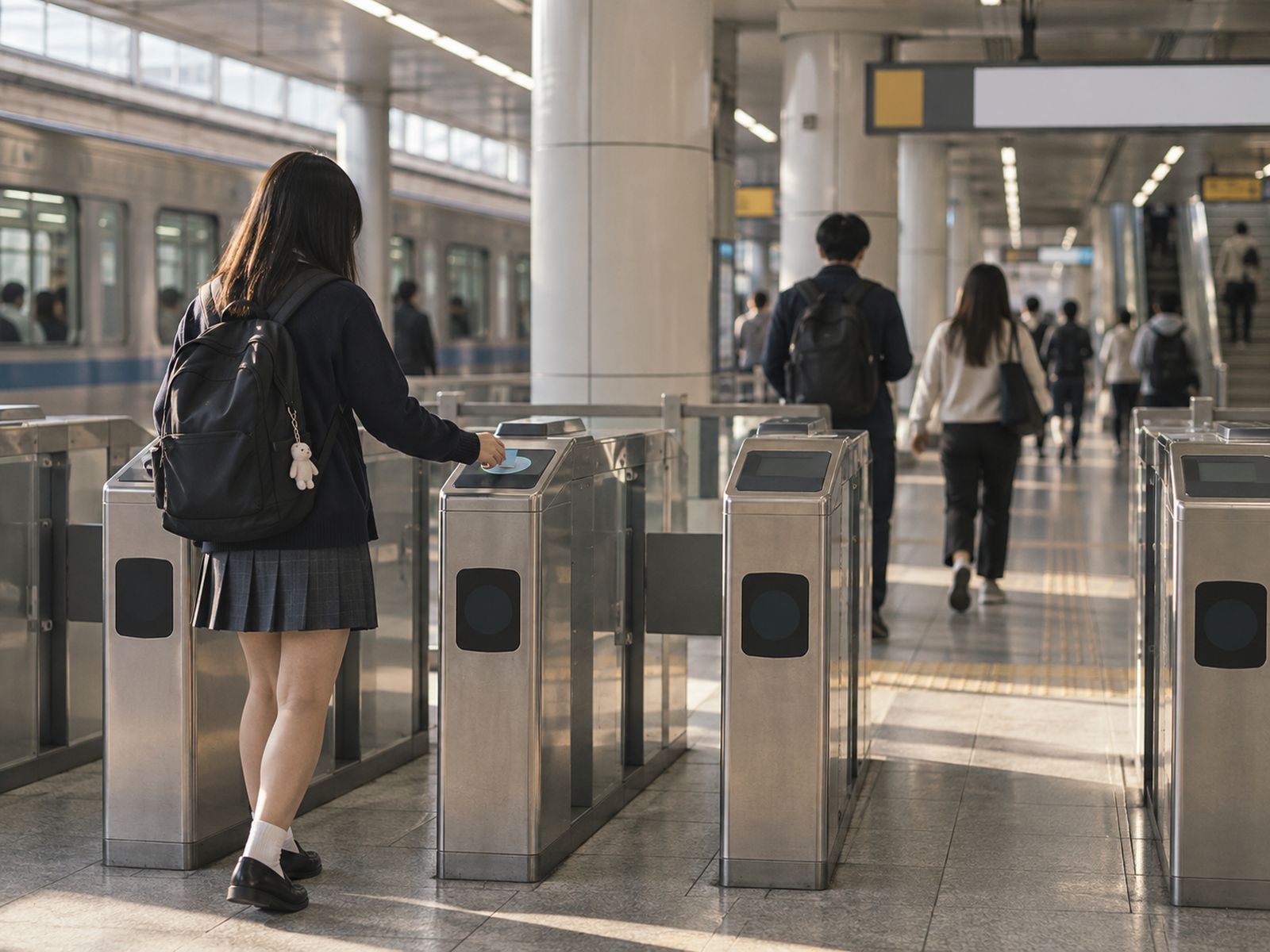
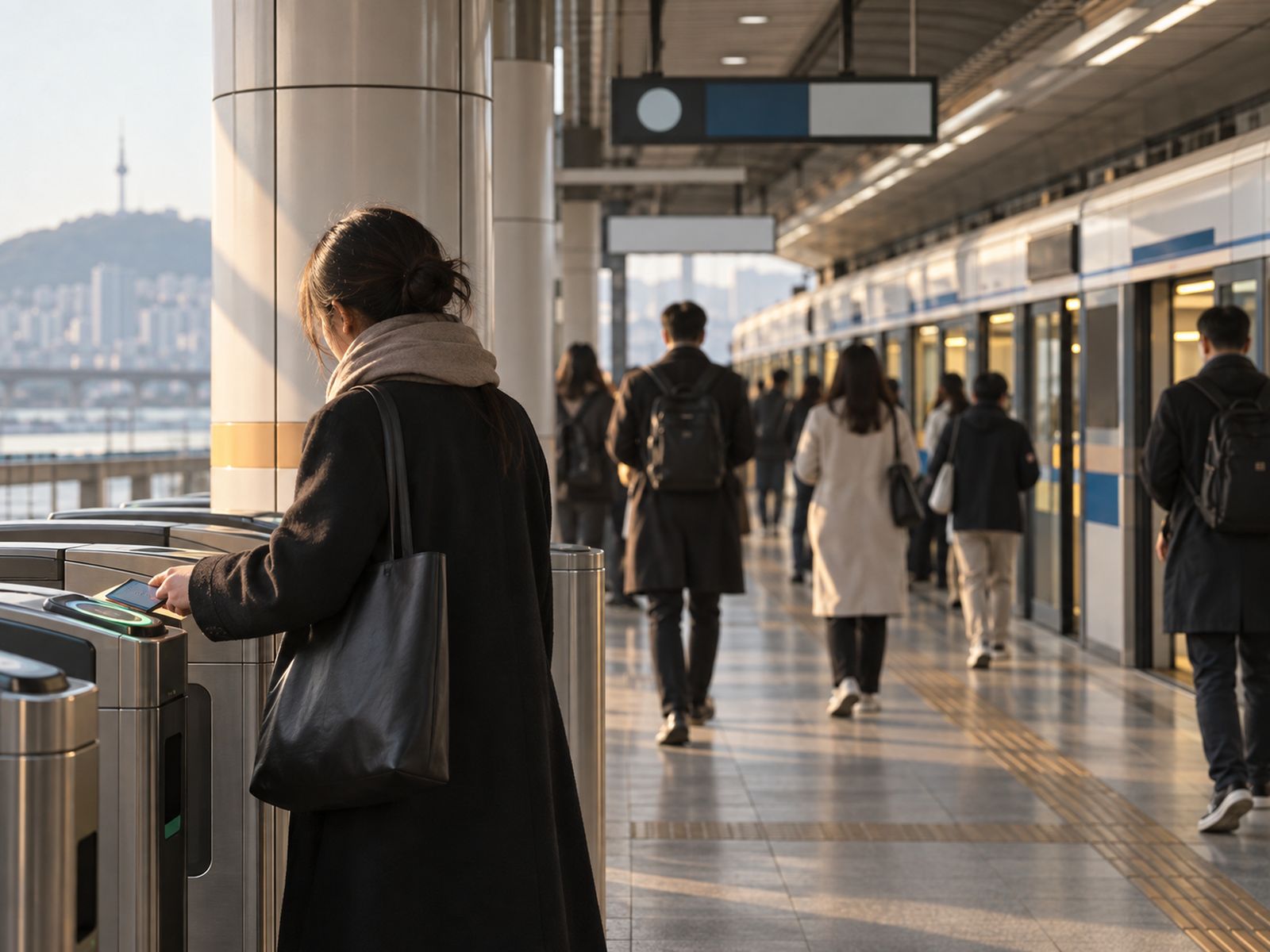
A single-journey ticket suits a one-off ride. It carries a deposit of ₩500 on top of the fare. The 500 won single-journey card deposit is refunded by placing the card on the deposit payment return machine after getting off at the destination station. At the gate, the ticket is read on the right-hand side. The single-use transportation ticket is touched on the T-money reader located on the right side of a turnstile.
| Ticket | Adult base fare | What else to know |
|---|---|---|
| Transportation card (T-money and similar) | ₩1,550 within ten kilometres | Card bought separately for ₩2,500 |
| Single-journey ticket | ₩1,650 within ten kilometres | Deposit of ₩500, refunded at the destination |
| Commuter pass | ₩68,200 for the within-Seoul pass | Fixed number of rides, covered below |
Longer journeys cost more on a card: 100 KRW for every 5km between 10 and 50km; 100 KRW for every 8km beyond 50km. Card users who start early also get a discount. 20% off the base fare from the first train of the day until 6:30 a.m.
Children and teenagers pay less. For a trip within the base distance, a child's single-journey ticket costs ₩550, and a teenager paying by card is charged ₩900. Preschoolers (under age 6) ride free of charge. If you buy a teenager or child card, note the registration step. Buying a teenager transit card requires an ID card, and teenager or child cards must be registered on the internet within 10 days of purchase.
How does the Seoul commuter pass work?
The commuter pass is a prepaid bundle of rides rather than an unlimited pass. Each pass gives you 60 rides within 30 days of charging. The version valid within Seoul costs ₩68,200.
Once either limit is reached, the pass stops working: the rides run out, or the window closes, whichever comes first. The pass is therefore worth weighing against a transportation card for your own trip rather than bought by default.
A useful allowance applies at the gates. A commuter-card holder who accidentally passes through a turnstile for a train in the wrong direction can exit the turnstile and re-enter on the other side within five minutes in the same station without being charged the fare again. There is a catch: The fee-free wrong-direction re-entry only applies at the station where the commuter card was first used that trip.
If you stop using the pass part-way through, the refund rule is set out by the operator. Unused single-journey and group tickets are fully refundable at any Seoul Metro station; a commuter ticket refunds the lower of remaining days or remaining rides. The transportation card price itself is not refundable.
Where is the commuter pass valid, and where does it stop?
The pass reaches beyond Seoul Metro's own lines. Prepaid commuter tickets are valid on Seoul Metro Lines 1-9 and on KORAIL and AREX sections within the Seoul area. That includes the Airport Railroad Express line (공항철도) within the Seoul area, which matters if you are heading towards the airport. Outside the covered sections, you need another way to pay for that part of the journey.
At Seoul Station (서울역), some transfers are not possible for commuter-pass holders. No transfer between Airport Railroad / Line 1 / Line 4 Seoul Station and Gyeongui-Jungang Line Seoul Station with a commuter ticket. If your route changes there, carry a transportation card with some balance as a backup.
Is the commuter pass worth it for a short trip?
It depends on how many rides you will take before the window closes. The table sets out what you pay under each option.
| Option | What you pay | What you get |
|---|---|---|
| Commuter pass (within Seoul) | ₩68,200 up front | 60 rides within 30 days of charging |
| Transportation card | ₩1,550 per ride within ten kilometres, plus distance charges | Pay as you go; bus-subway transfers on a card follow the rules below |
| Single-journey ticket | ₩1,650 per ride within ten kilometres, plus a refundable deposit | One ride per ticket |
Divide the pass price by the number of rides you realistically expect to take, and compare the result with the card fare for your usual journeys. If you also use buses, note that card transfers between bus and subway are discounted, within distance limits and with the highest basic fare applied. Transfer between bus and subway is free up to 10km, and up to 30km for Seoul metropolitan, Gyeonggi Express and Nonstop, and Incheon Express and metropolitan buses; the highest basic fare among the modes used is applied.
The transfer rules for cards have their own limits. Up to four transfers are allowed per trip, each within 30 minutes (within one hour between 9 p.m. and 7 a.m.); transferring to the same bus route is not permitted. Re-swiping the same transportation card within 15 minutes at the same station avoids a second base fare. Our separate guide to free transfer limits goes through these in detail.
Do I need a new ticket to change lines?
No. Transferring to another subway line does not require passing through any turnstiles or buying a separate ticket — follow the "Transfer" signs to the connecting platform. Follow the Transfer signs to the connecting platform without going back through the gates.
Can I bring a bicycle on the Seoul subway?
Only on certain days, and only in certain cars. Bicycles are allowed on subway trains only on Saturdays and national holidays, and only in the first and last cars. Plan any trip with a bicycle around those days, and board at the front or back of the train.
The luggage rule in the next section also mentions folded bicycles, but only to exempt them from its size and weight limit.
How much luggage can I take on the subway?
The operator restricts items above a size or weight limit, with exemptions. Items larger than 158cm (sum of length, width and height) or heavier than 32kg are restricted; wheelchairs, strollers and folded bicycles are exempted. If you are unsure about a large case, measure it before you set out.
If you need to cross the city without your bags, some stations have a storage and delivery service. T-luggage is a convenience facility in the station where you can store your luggage or use a delivery service to a station or the airport. T-Luggage service locations: Gimpo Airport, Seoul Station, Myeongdong, Hongik University, Jongno 3-ga, Jamsil. Counters take walk-in customers 09:00–22:00, and bookings are also taken online. T-luggage can be used offline by visiting the reception counter, or booked online at Tluggage.co.kr/eng.
Storage is charged by bag size for a base period, with an hourly charge after that. T-luggage storage fees cover a basic 4 hours, then an additional fee applies per hour beyond that, the same structure on weekdays and weekends.
| Bag size | Storage, weekday | Storage, weekend |
|---|---|---|
| Small | ₩3,000 | ₩4,000 |
| Medium | ₩4,000 | ₩6,000 |
| Large | ₩6,000 | ₩9,000 |
| Extra large | ₩9,000 | ₩13,000 |
Delivery is priced by bag size, by route (station to station or station to airport) and by weekday or weekend.
| Bag size | Station to station, weekday | Station to station, weekend | Station to airport, weekday | Station to airport, weekend |
|---|---|---|---|---|
| Small to medium | ₩17,000 | ₩25,000 | ₩20,000 | ₩29,000 |
| Large | ₩26,000 | ₩38,000 | ₩26,000 | ₩38,000 |
| Extra large | ₩31,000 | ₩45,000 | ₩31,000 | ₩45,000 |
Size bands are set by the operator; check which band your bag falls into when you book.
What other rules apply on board?
Pets. Pets must be carried in a fully covered pet carrier so the pet is not visible, and any unpleasant smell must not bother other passengers.
Riding without a valid ticket. The penalty is steep. 30 times the single-journey fare, for fare evasion, an invalid ticket, or refusing to show a ticket to an inspector.
Delays and cancellations. Fares are refunded for train delays and cancellations if requested within 14 days of the incident. Keep a note of the date, time and line if your train is held up.
What should I do if I leave something on a train?
Act quickly and call the lost and found centre for the line you were riding. Seoul Metro runs several, each covering a group of lines:
Line 1/2: City Hall Lost & Found Center (02-6110-1122). Line 3/4: Chungmuro Lost & Found Center (02-6110-3344). Line 5/8: Wangsimni Lost & Found Center (02-6311-6765/6768). Line 6/7: Wangsimni Lost & Found Center (02-6311-6766/6767). After hours: call center 1577-1234.
Have the line, the direction of travel, the approximate time and the car number to hand if you know them. Items do not stay with the subway for long. A found item is transferred to the jurisdictional police office within seven days of being acquired by the Lost & Found Center. After that, the item is with the police office for that area, so ask the lost and found centre where it was sent.
If you need an interpreter to make the call, the Korea Travel Hotline 1330 can help. It handles interpretation and complaints for tourists, and it can be reached on 1330 (in Korea), +82-2-1330 (from Overseas). 1330 can be reached by online voice call (Wi-Fi required for a free call), online chat, the 1330 Messenger (no download needed), KakaoTalk, Facebook, or Line.
What if something goes wrong at the gates or on the platform?
You entered on the wrong-direction platform. Commuter-pass holders can exit and re-enter without paying again, within the time limit and only at the station where the card was first used that trip, as described in the commuter pass section. With a transportation card, the card transfer rules cover re-swiping the same card at the same station within the stated window without a second base fare: Up to four transfers are allowed per trip, each within 30 minutes (within one hour between 9 p.m. and 7 a.m.); transferring to the same bus route is not permitted. Re-swiping the same transportation card within 15 minutes at the same station avoids a second base fare. If you are unsure, ask the station staff at the gate.
Your single-journey ticket deposit was not returned. Take the ticket to a deposit refund machine at your destination station before you leave, and ask the staff if the machine will not accept it.
You no longer need your commuter pass. Ask at a station about a refund on the unused part, using the rule in the commuter pass section.
You cannot make yourself understood. Call the tourist hotline from your phone, or use one of its chat channels. It offers interpretation for tourists.


Questions people ask
Is the Seoul commuter pass unlimited?
No. It is a set number of rides that must be used within a fixed window after charging. When either runs out, the pass stops working. See the commuter pass section above.
Can I use the commuter pass on the airport railway?
Only the AREX sections within the Seoul area are covered. Outside the covered sections you need another way to pay.
Can I take a bicycle on the subway on a weekday?
Only if that weekday is a national holiday. Bicycles are allowed only on Saturdays and national holidays, in the first and last cars.
Can I take a large suitcase on the Seoul subway?
Yes, as long as it is within the size and weight limits. For anything bigger, or to travel light, the storage and delivery service at some stations is an option.
Who do I call if I lose something on the subway?
The Seoul Metro lost and found centre for the line you were on. After hours, use the Seoul Metro call centre. Found items are transferred to the local police office within a week, so call soon.