Seoul subway fares: ages, transfers, discounts and refunds

WooDong · How we verify · sources checked SEP 6, 2026
Highlights
The short answer
Visitors pay Seoul subway fares by payment method and distance: within the base distance, a rechargeable transportation card costs less than a single-journey ticket, and longer card trips add a distance charge. Teenagers and children pay reduced fares; preschoolers ride free. Changing lines needs no new ticket, and with a card, subway-bus changes are free within the transfer limits, though the highest basic fare of the modes used applies. Prepaid and charge cards get a base-fare discount on trips started before the early-morning cut-off. Unused tickets are refundable, delayed or cancelled trips are refundable if you ask in time, and fare evasion carries a heavy penalty. Checked against Seoul Metro and T-money pages in September 2026.
Getting Around · Subway · Bus · Taxi
This guide is for visitors riding the Seoul subway. It covers what adults, teenagers and children pay, how a rechargeable transportation card compares with a single-journey ticket, how free transfers and the early-morning discount work, and how to claim a refund or stay clear of a penalty fare. The fares and rules come from Seoul Metro and T-money transit card pages checked in September 2026. Check the fare shown on the station machine or on the operator's site if a figure matters to your budget.
How much does an adult pay for a Seoul subway ride?
The adult fare depends on two things: how you pay and how far you ride. The base distance is the stretch a ride covers before the distance charges described below begin. With a transportation card, a trip within the base distance costs ₩1,550. The same trip within the base distance on a single-journey ticket costs ₩1,650, so for a trip of that length the card costs a little less.
On a transportation card, longer trips add a distance-based charge on top of the base fare. The rule is: 100 KRW for every 5km between 10 and 50km; 100 KRW for every 8km beyond 50km.
In other words, a short ride and a long ride can cost different amounts, even on the same card. The fare figures in this guide are for the base distance, so on a card, expect to pay more on a ride that goes beyond it.
Should you use a transportation card or a single-journey ticket?
Within the base distance, a card ride costs less than a single-journey ticket, and the transfer and early-morning discounts described below are published for card users. Weigh that against the price of the card itself, which is not refunded. A single-journey ticket suits a one-off trip, or a moment when you have not yet bought a card.
| Transportation card | Single-journey ticket | |
|---|---|---|
| Adult fare, base distance | ₩1,550 | ₩1,650 |
| Upfront cost | ₩2,500 for the card itself, which is not refunded | ₩500 deposit, returned at the deposit return machine after you get off |
| Free transfers to buses | Yes, within the time and distance limits below | The published transfer rules cover cards, not these tickets |
| Early-morning discount | Yes, on prepaid and charge cards | Not included |
Buying and loading a card
T-money transit cards can be bought at any subway ticket office. The card itself costs ₩2,500, and that purchase price is separate from the money you load to pay for rides. The operator describes the two kinds of transportation card this way:
- Prepayment card: A prepayment transportation card is used by charging money in advance and recharging for continuous use when the balance runs out.
- Deferred payment card: A deferred payment transportation card is a credit card with the RF transportation feature added, so the public transportation charge is included in the monthly credit card payment.
For a short visit, the prepayment kind is the one to look for, since the deferred kind depends on a credit card with the transport feature built in and a monthly bill.
Each traveller needs their own card or ticket. The rule is stated plainly: One ticket is valid for one person; the subway system cannot accept multiple passengers on one card.
Using a single-journey ticket
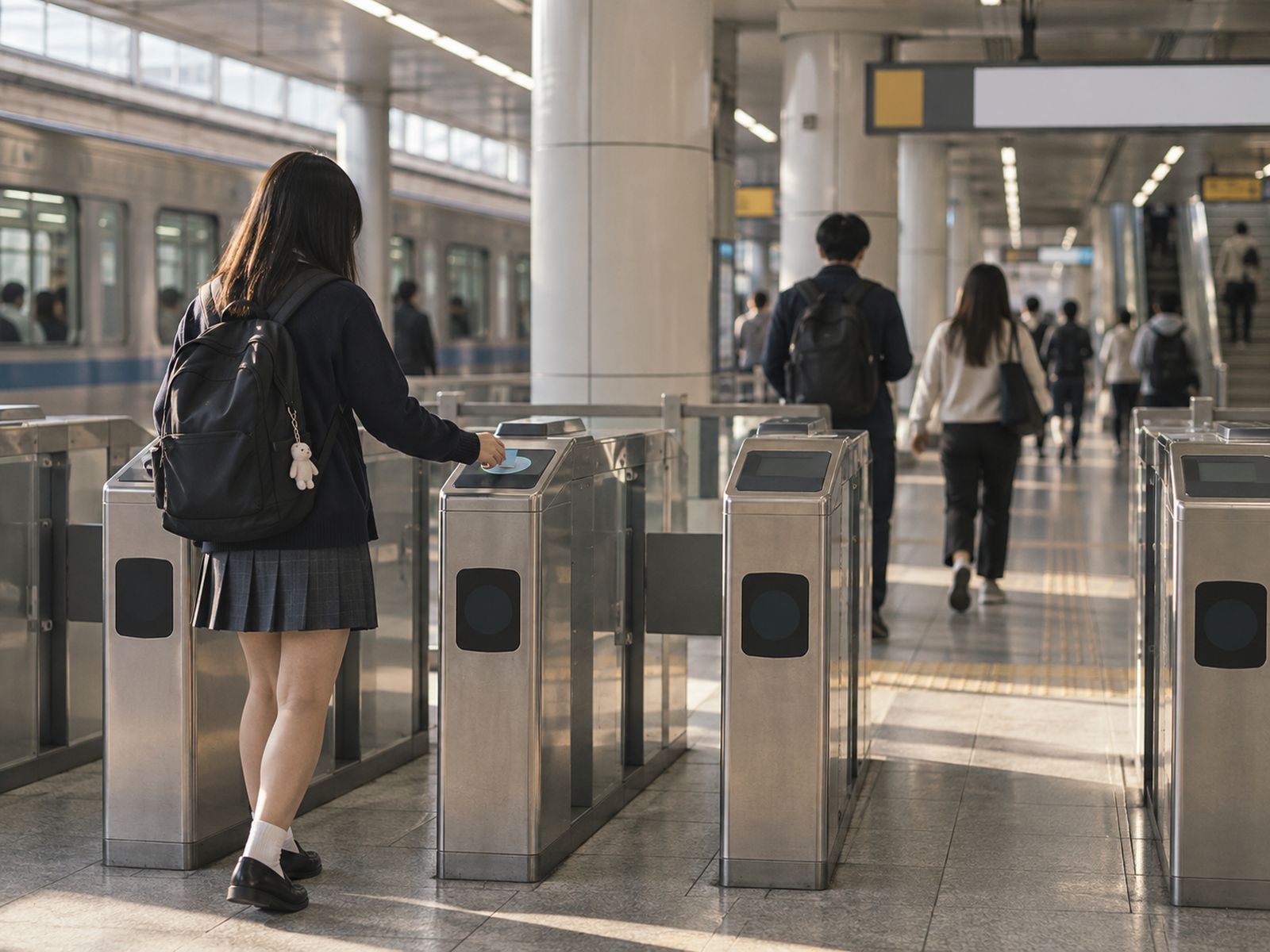
At the gate, a single-journey ticket is touched on the reader: The single-use transportation ticket is touched on the T-money reader located on the right side of a turnstile.
Keep the ticket until the end of your trip, because it carries a deposit. When you arrive: The 500 won single-journey card deposit is refunded by placing the card on the deposit payment return machine after getting off at the destination station.
What do teenagers and children pay on the Seoul subway?
Fares for younger riders depend on age and on the kind of ticket used. The age bands for discounted cards are: Child card: 6 to 13; teenager card: 13 to 19.
The fares published for younger riders are:
- Preschool children: Preschoolers (under age 6) ride free of charge.
- Children: ₩550 on a single-journey ticket, for a trip within the base distance
- Teenagers: ₩900 with a transportation card, for a trip within the base distance
Discounted cards come with conditions that matter to visiting families: Buying a teenager or child transportation card requires an ID card, and the card must be registered online within 10 days of purchase.
If registering a card is not practical on a short trip, ask the staff at the station ticket office which fare your child should pay before you buy anything. Each child who pays a fare still needs their own card or ticket, under the same one-rider-per-card rule that applies to adults.
How do transfers between subway lines and buses work?
Changing from one subway line to another inside a station does not need a new ticket. As Seoul Metro puts it: Transferring to another subway line does not require passing through any turnstiles or buying a separate ticket — follow the "Transfer" signs to the connecting platform.
Changes between the subway and a Seoul city bus are handled by the transfer discount, which works like this: Transfer between bus and subway is free up to 10km, and up to 30km for Seoul metropolitan, Gyeonggi Express and Nonstop, and Incheon Express and metropolitan buses; the highest basic fare among the modes used is applied.
Whether a change counts as a transfer depends on timing and on how many times you change. The rules are: Up to four transfers are allowed per trip, each within 30 minutes (within one hour between 9 p.m. and 7 a.m.); transferring to the same bus route is not permitted. Re-swiping the same transportation card within 15 minutes at the same station avoids a second base fare.
These transfer rules are published for transportation cards, not for single-journey tickets or commuter cards. Because each change has to fall within the transfer window, keep an eye on the clock if you stop for a coffee between the train and the bus.
Is there an early-bird discount on the Seoul subway?
Yes, for card users who start their journey early in the morning: 20% off the base fare from the first train of the day until 6:30 a.m.
The discount applies to prepaid transportation cards and charge cards. A single-journey ticket does not qualify, so if you are setting off for an early flight or a day trip, use your card rather than buying a ticket at the machine.
Are there discounts for groups, long stays or residents?
Groups travelling together on the same section and route can get a reduced fare, subject to a minimum group size. The rules are:
- For a group of 20 or more travelling the same section and route, the fare for every 20th person is free.
- A one-way group fare is calculated by multiplying the number of people by a 20%-discounted adult fare, then rounding the result.
For a long stay with a daily commute, there is also a commuter ticket, valid for 60 rides within 30 days of charging. It is a different product from a pay-as-you-go card, and it has its own refund and re-entry rules, covered below.
The K-Pass fare refund scheme is tied to resident registration: Only residents registered in a participating local authority, aged 19 or over, are eligible for the K-Pass refund scheme.
How do I get a refund on the Seoul subway?
Refund rules differ depending on what went wrong, so start by working out which case you are in.
An unused ticket
Unused single-journey and group tickets are fully refundable at any Seoul Metro station; a commuter ticket refunds the lower of remaining days or remaining rides. The transportation card price itself is not refundable.
That last point matters when you cash out before leaving Korea: the purchase price of the card stays spent, even though the balance on it can come back to you.
A delayed or cancelled train
Fares are refunded for train delays and cancellations if requested within 14 days of the incident.
Make the request soon after the disruption rather than waiting until you are home, and ask station staff how to lodge it if you are unsure.
Money left on your T-money card
Before you fly home, you can take the remaining balance off your card. Where you do it decides how much can be refunded on the spot:
- At a subway station customer service centre: on-the-spot refund only if the balance is under 50,000 KRW, minus a 500 KRW fee.
- At a partner convenience store (GS25, CU, 7-Eleven, Ministop, emart24): on-the-spot refund only if the balance is under 20,000 KRW, minus a 500 KRW fee.
Larger balances cannot be refunded on the spot at either place, so it helps to spend the card down over your last few days. A convenience store can take a small leftover balance; a station customer service centre has the higher on-the-spot limit of the two.
What is the penalty fare on the Seoul subway?
The penalty for riding without a valid ticket is set as a multiple of the fare: 30 times the single-journey fare, for fare evasion, an invalid ticket, or refusing to show a ticket to an inspector.
For comparison, the single-journey fare it is based on is ₩1,650 for a trip within the base distance, so a penalty costs far more than the ride would have. Avoiding it is straightforward:
- Tap in at the gate every time, with a separate card or ticket for each person in your group.
- Keep your card or ticket to hand until you have left the station, because refusing to show a ticket to an inspector counts as well.
- If the gate rejects your card, speak to station staff rather than following someone else through.
What if something goes wrong at the gate or with your card?
Match your situation to the list below before paying again.
- You tapped in on the wrong platform side with a transportation card. The re-tap rule in the transfer section above applies when you tap the same card again at the same station within the stated window.
- You tapped in on the wrong side with a commuter card. A commuter-card holder who accidentally passes through a turnstile for a train in the wrong direction can exit the turnstile and re-enter on the other side within five minutes in the same station without being charged the fare again. The fee-free wrong-direction re-entry only applies at the station where the commuter card was first used that trip.
- Your card is damaged. A T-money balance can be refunded at any subway station; a damaged card needs a refund request form and takes about seven days.
- Your prepaid balance has run out. Recharge the card before you tap in again. As the operator describes it: A prepayment transportation card is used by charging money in advance and recharging for continuous use when the balance runs out.
- You need help with the card itself. Call the T-money transit card customer centre on 1644-0088.
If a gate or machine problem leaves you unsure what you owe, ask the staff at the station before you leave.


Questions people ask
Do children ride the Seoul subway for free?
Preschool children ride free. Older children and teenagers pay reduced fares; the section on teenagers and children above explains the age bands and the card registration rules.
Can a family share a T-money card?
No. A card or ticket covers a single rider, so each person who pays a fare needs their own.
Do I pay again when I change subway lines?
No. Changing lines inside a station needs no new ticket; follow the Transfer signs. Changes between the subway and a city bus are free with a transportation card within the transfer time and distance limits, with the highest basic fare among the modes used applied.
Does the early-bird discount work with a single-journey ticket?
No. It applies to prepaid transportation cards and charge cards, so tap in with your card if you set off early.
Can I get my leftover T-money balance back before I fly home?
Yes. A subway station customer service centre or a partner convenience store can refund a small balance on the spot, minus a fee. The refunds section above sets out the limits at each.