K-ETA for Korea: who needs it, fees, timing and validity

MK Lee · How we verify · sources checked SEP 6, 2026
Highlights
The short answer
Visitors entering Korea without a visa for a short stay, such as travel, family visits, events or non-commercial business, need an approved K-ETA before boarding the flight or ship, unless they are exempt, for example travellers inside the official age exemption, transfer passengers who do not enter Korea, or visa holders. You apply on the official website or app and pay a per-person fee by card. Allow time: there is no expedited service, and assessment can take longer when applications surge. One approval covers repeat visits for several years, capped by passport expiry, and a reissued passport needs a new application. It is not a visa. Checked against the official K-ETA pages in September 2026.
Airport Transfers · Incheon · Gimpo · Busan
This guide covers K-ETA (Korea Electronic Travel Authorization) from the point of view of a traveller planning a trip: who has to apply, who is exempt, what the application asks for, what it costs, how long the assessment takes, how long an approval lasts and what to do when a payment fails or a detail changes. It is written for independent visitors flying or sailing to Korea on a passport that does not need a visa for a short stay. Every fee, period and rule below is drawn from the official K-ETA pages; re-read the official site in the week before you apply in case anything has changed.
Do I need a K-ETA to visit Korea?
K-ETA is aimed at people who can enter Korea without a visa. The official description of who must apply is:
Foreigners entering Korea without a visa for a short stay for travel, visiting relatives, events or conferences, or business with no commercial activity, who are not exempt.
If that describes your trip, the approval has to be in place before you travel, not after you land:
Eligible nationals must obtain K-ETA approval before boarding the flight or ship; applying after boarding or while already in Korea may lead to refusal of approval or entry restrictions.
In practice the K-ETA belongs on the same checklist as your passport and flight booking, and it is worth sorting out as soon as your dates are fixed rather than in the days before departure.
How long can I stay once I arrive?
On the K-ETA eligibility list, the nationalities below are shown with these allowed periods of stay. That stay is a separate thing from how long the K-ETA approval itself remains valid (covered further down). A few examples from the list:
| Nationality | Stay period listed |
|---|---|
| United States | 90 days |
| United Kingdom (British citizen) | 90 days |
| Canada | 6 months |
| Japan | 90 days |
| Taiwan | 90 days |
| Singapore | 90 days |
| Thailand | 90 days |
| Malaysia | 3 months |
If your nationality is not in this sample, look it up on the official eligibility page rather than assuming it matches a neighbouring country.
Who is exempt from K-ETA?
Several groups do not need to apply at all. The official exemption list reads:
Diplomatic and official passport holders, US Armed Forces on SOFA status, aircraft and ship crew, ABTC (APEC) holders, transfer passengers, registered foreigners and visa holders, UN passport holders, and applicants 17 and under or 65 and over.
Two of these categories are worth a closer look.
Children and older travellers. The age exemption is measured on the day you enter Korea, not the day you book or apply. The rule is:
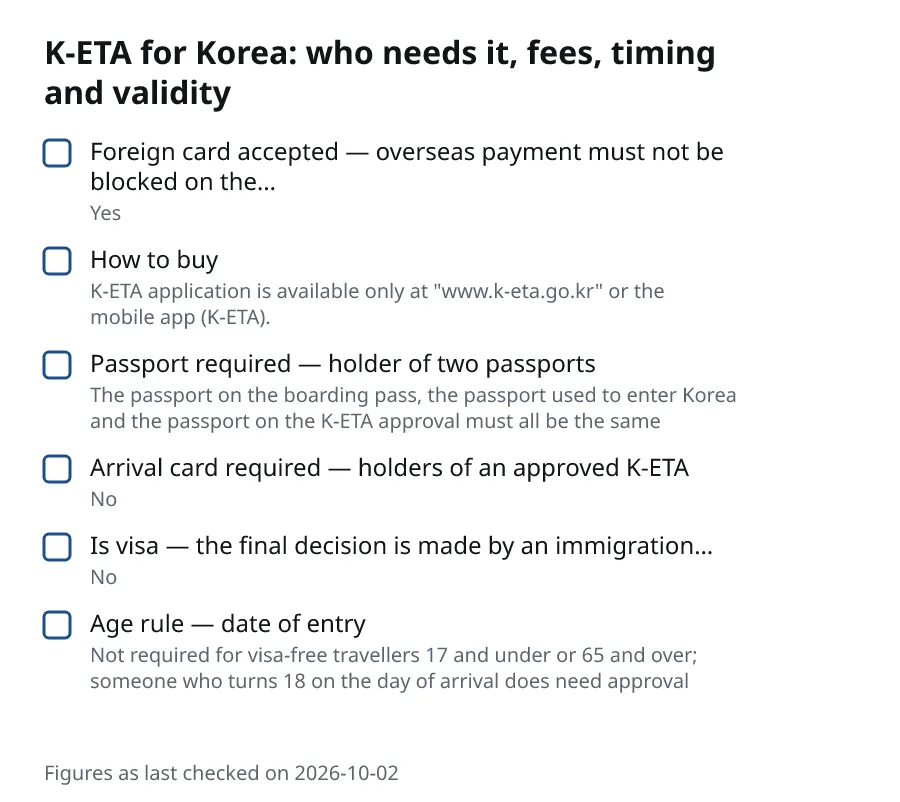
Not required for visa-free travellers 17 and under or 65 and over; someone who turns 18 on the day of arrival does need approval.
So a teenager whose birthday falls during the trip should be checked against the entry date. When in doubt, check the date of birth against the arrival date on the ticket, not the departure date from home.
Transfer passengers. Changing planes in Korea without passing through immigration does not usually require a K-ETA, but the exemption has limits:
Transfer passengers are exempt unless they must enter Korea because of an itinerary change or to reclaim baggage.
If your plans could mean leaving the transit area, for example to collect checked bags between flights, treat yourself as someone entering Korea and apply.
How do I apply for a K-ETA, and what do I need?
Applications go through the official channels only:
K-ETA application is available only at "www.k-eta.go.kr" or the mobile app (K-ETA).
Have these ready before you start:
- Valid passport, valid e-mail address, ID photo, and a credit or debit card for the fee.
The photo has its own rules. On head coverings the guidance says:
Religious head covering is allowed in the photo provided the face from forehead to chin is clearly visible.
Fill in every field yourself and check it twice, including passport number, name spelling and travel details. The consequence of a mistake is set out plainly:
K-ETA approval will be refused or cancelled if false or inaccurate information is submitted, and the applicant may face penalties or entry restrictions under Korean law; this applies equally to all accompanying applicants.
That last clause matters for families and groups: the same rule applies to every accompanying applicant, so check each person's details with the same care.
Lookalike services exist. The official site warns:
Similar agencies and phishing sites charge high fees while claiming to act as a K-ETA application or expedited-service agent.
The address to type in yourself is www.k-eta.go.kr, or use the official K-ETA app.
How much does K-ETA cost, and which cards work?
The fee is charged per person, so a family pays once for each applicant who is not exempt:
| Item | Detail |
|---|---|
| Application fee | ₩10,000 per person |
| Cards issued outside Korea accepted (if overseas payment is not blocked on the card) | Yes |
| Accepted networks | VISA, MASTER, JCB, AMEX, Diners Club, DISCOVER, UnionPay or Alipay+ |
A card issued abroad works as long as overseas payments are not blocked on it. If your bank lets you switch overseas online payments on and off, turn them on in your banking app before you reach the payment step.
The fee pays for the assessment, not for the outcome:
The K-ETA application fee is non-refundable even if the application is denied.
The related guide on the K-ETA refund policy after a rejection goes through that situation in more detail.
How long does K-ETA approval take?
The official guidance on timing is:
K-ETA assessment typically takes 72 hours or less, but may take longer during an unexpected increase in applications.
There is no way to jump the queue:
Applications are reviewed in the order they are received, and there is no expedited service to speed up processing for specific applications.
Any website offering a faster turnaround for an extra charge is not the official service (see the warning in the previous section). The practical advice is to apply as soon as your travel dates are fixed rather than in the last few days, since an unexpected surge in applications can stretch the assessment.
How long is a K-ETA valid, and can I use it more than once?
An approval lasts for 3 years, but not beyond the expiry date of the passport it was issued against. If your passport runs out sooner, the K-ETA runs out with it.
Older approvals follow an earlier rule:
Applications submitted before July 3, 2023 are valid for 2 years instead of 3.
Within its validity an approval is not used up by a single trip:
K-ETA can be used multiple times within its validity period.
The stay period listed for your nationality, shown earlier, is a separate matter from how long the approval remains valid.
Is K-ETA a visa, and do I still need an arrival card?
Two questions about what an approval does and does not do, side by side:
| Question | Answer |
|---|---|
| Is K-ETA a visa? | No |
| Do approved K-ETA holders need to submit an arrival card? | No |
An approval is not a visa. The final decision on entry is made by the immigration officer at the port of entry, so an approved K-ETA does not settle the question on its own.
The arrival card point is a small practical gain on landing:
Travellers with K-ETA approval are exempt from submitting the arrival card when entering Korea, allowing faster passage through entry immigration.
When do I have to apply for a K-ETA again?
An approval is tied to one passport and to the answers you gave. The official rule on when a fresh application is needed is:
A new K-ETA application is required if the passport is reissued, or if there are changes to criminal record or infectious disease information, even if the current K-ETA has not expired.
A renewed passport, or a replacement after loss, therefore needs a new K-ETA, even if the old approval had years left to run. Some changes do not trigger a new application:
A change of occupation after approval does not require re-applying.
Travel details are different again. If your travel information changes after approval, it has to be updated on the official site:
If travel information changes after K-ETA approval, it must be updated on the K-ETA website's Update Travel Information page, or entry may be denied.
Travellers with two passports. Use one passport consistently for the whole journey:
The passport on the boarding pass, the passport used to enter Korea and the passport on the K-ETA approval must all be the same.
Before you check in, confirm which passport your approval was issued against and keep the other one put away.
What if my payment fails or my application is refused?
A card payment error. One failure at the payment step is the card's own payer-authentication (security) check. Who deals with it is set out in the official FAQ:
A 3DS payer-authentication error at payment must be taken up with the card issuer, not with the K-ETA centre.
For that error, contact your card issuer. Separately, check that overseas payment is not blocked on the card, since the fee may not go through if it is. If the same card keeps failing, a card on another of the accepted networks is the next thing to try.
A refused application. The fee is not returned, as noted above. If you think the refusal came from an error in your form, ask through the official inquiry form described below before paying for a new application. Holding off on non-refundable bookings until the approval is in hand avoids the worst of this.
Getting help. The K-ETA Center lists a phone number, 02-2666-0463, but it points applicants to the written channel instead:
In principle the K-ETA Center does not provide telephone or face-to-face consultations; questions must be submitted through the Ask Us inquiry form.
Send the question through that form with your application details, allow time for a reply, and keep your travel dates flexible until the answer arrives. The official K-ETA site is the place to confirm anything on this page before you pay.

Questions people ask
Can I apply for a K-ETA after I land in Korea?
You should not. Approval has to be obtained before boarding the flight or ship, and applying after boarding or once in Korea may lead to refusal of approval or entry restrictions. See the first section of this guide.
Do children need their own K-ETA?
Not if they fall within the official age exemption for visa-free travellers, which is measured on the date of entry. The exemption section explains exactly where the age line falls.
Can I pay extra to get my K-ETA approved faster?
No. Applications are handled in the order they arrive, and sites selling a faster service are not official. Apply as soon as your dates are fixed.
Do I need a new K-ETA with a new passport?
Yes. A reissued or replaced passport needs a fresh application even if the old approval had not expired. A change of job does not.
Who do I contact about a card payment error on the K-ETA site?
For a payer-authentication (security check) error, your card issuer, not the K-ETA Center. It is also worth checking that overseas payment is not blocked on the card, then trying again or using a card on another accepted network.